If friction is not visible in the reporting, the reporting is broken.
Large-scale SAP transformations are inherently volatile. They involve complex technical architectures, legacy data debt, and massive organisational change. A status report that shows unbroken green across all workstreams is not an achievement. It is a warning sign.
The system integrator controls the reporting mechanism, which means they control the narrative. To govern effectively in the Delivery Zone, the board must ignore the narrative and look for the specific data points that SIs use to hide programme drift.
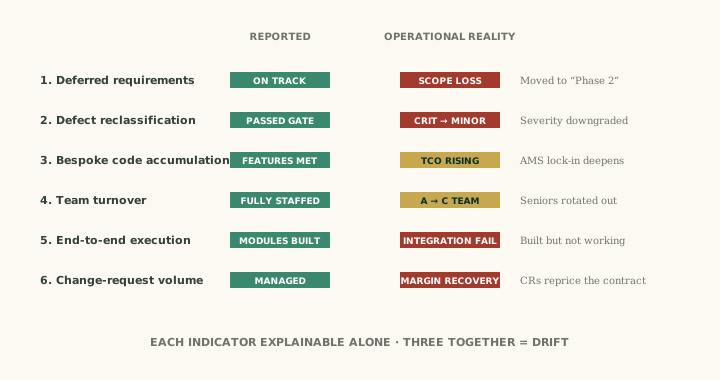
Here are the six indicators that expose true programme health.
1. Deferred requirements
Scope that was originally promised for go-live but is quietly being moved to Phase 2 or post-go-live enhancements. This is not agile delivery. It is a mechanism to protect the SI’s go-live date while delivering less value than the contract committed to.
2. Defect ratios and reclassification
SIs are incentivised to hit phase gates to trigger milestone payments. A common tactic is to reclassify Critical or High defects as Medium or Minor so the gate can be passed. If the severity of defects drops suspiciously right before a milestone, the reporting is being manipulated.
3. Bespoke code accumulation
Every line of custom code breaks the standard architecture, increases your long-term Total Cost of Ownership, and locks you deeper into the SI’s Application Management Services contract. The health report must track customisation as a primary risk metric — not buried in an appendix.
4. Team turnover
The A team sells the contract. The C team delivers it. If the SI is rotating lead architects or replacing senior resources with junior staff post-signing, the programme will drift. Resource continuity is a leading indicator of delivery quality.
5. Actual business execution
SIs love to report that a module is built. But if that module cannot integrate with legacy systems or handle actual business data, it is useless. The only metric that matters is end-to-end business execution — not technical completion in a vacuum.
6. Contract expansion
Are Change Requests being driven by changing business needs, or by the SI discovering technical complexities they failed to identify during Discovery? If the latter, the SI is using CRs to recover margin on a poorly scoped contract — and your programme is being repriced one CR at a time.
What this means at board level
Each indicator on its own can be explained. Two together is a pattern. Three together is a programme that has already drifted — whether or not the executive summary admits it.
A board that cannot independently verify these six indicators is operating blind.