Your SAP transformation will fail. It will fail quietly, in a thousand small compromises, long before it fails publicly — not because of the technology, but because nobody was truly holding the program to account.
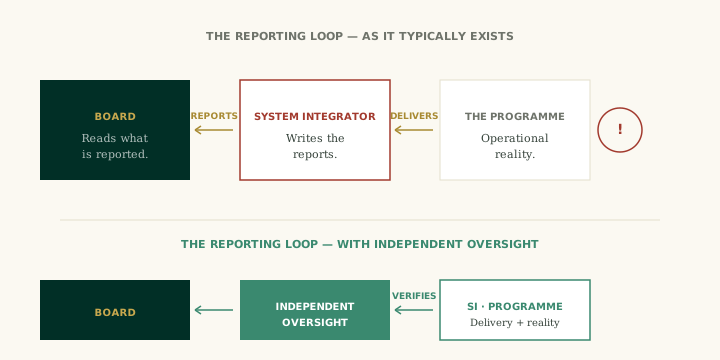
The cause is almost always the same: the partner responsible for building your new core is the last partner who should be allowed to govern it.
For a board of directors, an SAP transformation is one of the most significant capital allocations the enterprise will make in a decade. Yet the governance mechanisms relied upon to protect that investment are fundamentally flawed.
The anatomy of programme drift
SAP transformations rarely fail overnight. They drift.
Programme drift occurs when reporting stops reflecting operational reality. The system integrator’s commercial incentive is to protect their scope, expand their contract, and reach go-live — regardless of whether the business is actually ready. They are not incentivised to surface problems; they are incentivised to manage them quietly.
The board is presented with a narrative of control. The reality on the ground is mounting technical debt, deferred scope, and compromised business value.
Think about the information you actually receive:
Status reports authored by the SI whose performance is being reported on. Risk logs filtered through multiple layers of project management before reaching the steering committee. Phase gates treated as administrative formalities rather than rigorous tests of readiness. When a programme is governed by those delivering it, optimism bias is inevitable.
Governance is not theatre
True board-level governance in the Decision Zone requires three things the SI cannot provide:
If the same firm benefits from the programme reaching go-live, they cannot be the firm that tells the board whether go-live is safe.
Governance without technical authority is reputational cover. The board needs people who can read the architecture, the defect logs, and the integration tests — not just the executive summary.
Independent oversight that cannot stop a phase gate is not oversight. It is documentation of a decision that was always going to be made.
Without all three, governance is theatre. If the SI is grading their own homework, your board is operating blind. A project sponsor signing off on an SI report is simply co-signing the SI narrative. The resulting gap between what the board is told and what is actually happening is where millions of dollars in shareholder value are destroyed.
The antidote to optimism bias
The board’s role is not to manage the programme. It is to ensure that someone independent of the programme is doing so on its behalf.
Your transformation requires more than software. It requires authority.