By the time a board commissions an independent intervention, the average SAP programme has already been drifting for four to seven months. The cost of that drift — in defects accumulating, in scope quietly slipping, in milestone payments triggered against work that has not been done — is almost always materially larger than the cost of the intervention itself.
The first thirty days are how that drift gets quantified. And stopped.
This piece is about what a board actually gets back from a thirty-day independent read — not the process behind it. The process is straightforward. The outputs are what change the conversation in the boardroom.
What the board can decide by Day 30 that it cannot decide on Day 1
A board considering intervention is usually stuck in a specific way: it has lost confidence in the SI’s reporting, but does not yet have an alternative version of the truth. Until it does, it cannot defensibly make any of the decisions that actually matter:
Whether to approve the next phase gate. Whether to hold the go-live date. Whether to expand the contract on the basis of the CRs the SI is now requesting. Whether to escalate to the executive committee. None of these can be made on the basis of reporting written by the team being assessed.
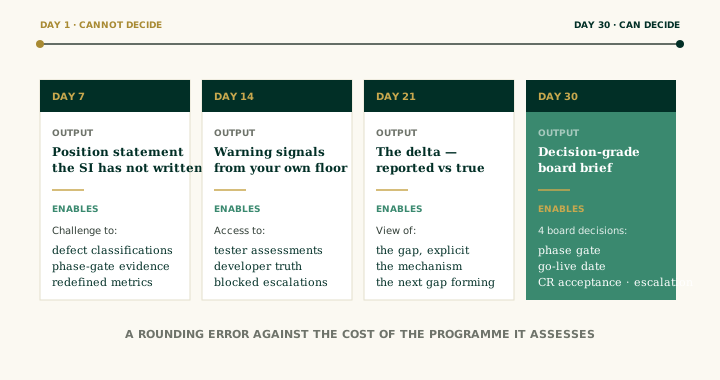
A thirty-day read produces the alternative version of the truth. Below is what each week delivers — framed by the output the board receives, not the activity behind it.
Day 7 — The position statement the SI has not written
Within seven days, the board has an independent reading of the architecture, defect logs, test results, integration map, and change-request register. Items that almost always surface in the first week: defect severity classifications that do not match the defect descriptions; phase-gate decisions made on evidence that, on inspection, does not support them; workstream metrics that have been quietly redefined to make the dashboard work.
This is the document the SI has not produced — not because they could not, but because they had no incentive to. It is also the document that ends most of the “but the report says we’re green” arguments in the steering committee.
Day 14 — The warning signals already being raised on your delivery floor
By the end of week two, the board has access to evidence it cannot get from the SI: the assessments of the people closest to the build. The recurring finding: most intervention discoveries are not new. They are existing knowledge that has been blocked from travelling upward. The honest version of programme health usually exists inside your own organisation. It just is not what the board has been reading.
Three weeks before go-live at a global manufacturer, the lead tester had told the project team he did not see how the programme could safely proceed. The board only heard the line through an independent intervention. By that point, it was almost too late.
Day 21 — The delta between what you have been told and what is true
By the third week, the board sees not just where the programme actually stands, but how the gap was constructed — which reporting choices, which severity-classification practices, which change-control workarounds. Closing this gap matters less than understanding the mechanism that produced it. Because the next gap is already forming inside the same mechanism.
Day 30 — The four decisions the board can now make
By Day 30, the board can decide — with evidence — whether to approve or hold the next phase gate, whether to move the go-live date, whether to accept or reject the SI’s recent change requests, and whether the programme’s governance structure itself needs to be reset. None of these decisions are recommended by the intervention. They are made possible by it.
What it costs to not have this
Boards that do not commission an independent read at the moment of doubt typically end up commissioning one anyway — six to twelve months later, after the gap has materialised in a missed go-live, a defect leak into production, or a regulator letter.
The cost at that point is not the intervention. It is everything the intervention would have prevented:
Milestone payments triggered against work that did not meet the milestone. Hypercare contracts extended into permanent operational support. Scope deferred to a Phase 2 that gets renegotiated upward. And the harder cost: the reputational exposure of an executive team that approved a go-live the evidence did not support. The thirty-day read is the only mechanism that gets that decision out of the executive’s lap and back onto evidence.
The cost-benefit, plainly stated
A thirty-day independent read is, in financial terms, a rounding error against the cost of the programmes it assesses. It is, in governance terms, the single highest-leverage spend the board makes in the entire transformation.
The question is not whether you can afford to pay for thirty days of independent oversight. It is whether you can afford not to know what the next six months were going to surface anyway.