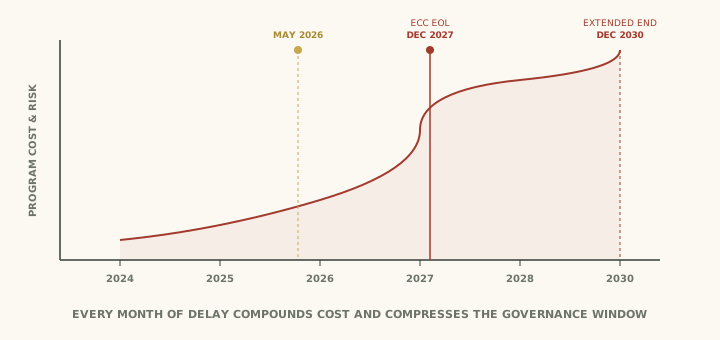
For enterprise boards, the question surrounding SAP Enterprise Central Component is no longer whether a migration is necessary. It is whether the organisation has enough time left to govern one properly.
The deadlines of May 2026 and December 2027 are not IT milestones to be managed by the technology function. They are strategic inflection points that carry material financial, operational, and governance risk — and they are approaching faster than most program timelines can accommodate.
The 2027 and 2030 deadlines explained
The SAP ecosystem is facing two major transition dates that boards must actively monitor:
After this date, organisations remaining on ECC will require SAP Extended Maintenance, which carries a significant cost premium and does not unlock the platform innovations that justified the migration in the first place.
After this date, customer-specific maintenance arrangements apply, with rising costs and diminishing access to platform updates. 2030 is not a fallback — it is a more expensive way to arrive at the same migration decision.
The longer an organisation delays, the higher the cost and complexity of migration become — and the narrower the window for controlled, evidence-based decision-making.
The compounding cost of delay
Postponing the migration decision is not a neutral position. It is a strategic risk that compounds over time.
As the 2026 and 2027 deadlines approach, the availability of experienced SAP talent will contract, and implementation costs will rise. Organisations that delay will find themselves competing for constrained resources at precisely the moment when program pressure is highest.
Relying on extended maintenance means paying a premium to preserve a system that is no longer receiving strategic investment. Boards must demand a clear return-on-investment analysis that compares the true cost of early, governed migration against the compounding costs of delay.
The filtered reporting problem
As organisations move closer to these deadlines, reliance on system integrators increases — and so does the governance risk.
System integrators operate under significant pressure to demonstrate progress. This creates the conditions for what is widely recognised as filtered reporting, or the watermelon effect: a program’s status is reported as green to the board while underlying issues remain unresolved.
It approves phase gates on the basis of reporting it has no mechanism to independently verify. That is not governance. That is reputational exposure.
Establish independent oversight now
To navigate the 2026 and 2027 deadlines with governance control intact, enterprise boards must implement an independent validation and verification structure that operates outside the delivery team.
The SAP ECC deadlines are not moving. The organisations that will navigate them successfully are those that establish independent governance oversight now — while there is still time to make controlled, evidence-based decisions.