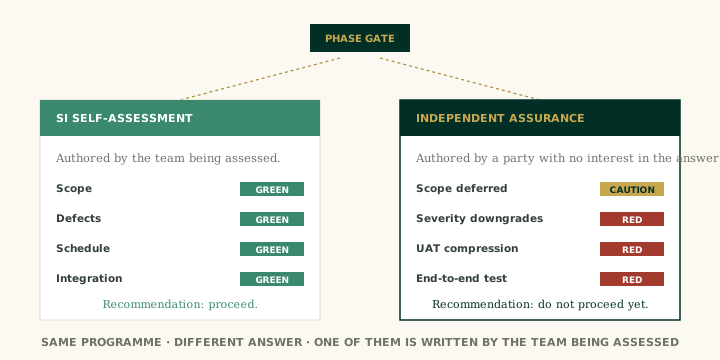
The most misleading status in SAP transformation governance is a consistently green project report. When your multi-million-dollar ERP programme risk appears low month after month, it is often a sign of programme drift — and a disconnect between reporting and reality.
This phenomenon, commonly known as watermelon reporting, presents a green exterior while underlying issues remain unresolved.
The story behind the green
At a global manufacturing client, board members received green status updates while a lead tester on the ground raised serious concerns.
“I do not currently see how the programme can safely proceed to go-live.”
Despite critical defects affecting key functionalities, the systems integrator’s reports suggested steady progress and control. The board never heard the tester’s line.
This discrepancy is not accidental. It reflects a governance model where the systems integrator effectively grades their own work. To protect the timeline, testing phases are compressed, defects deferred, and risks understated — creating an illusion of progress that masks real vulnerabilities until escalation becomes unavoidable.
The value of independent phase-gate assurance
Independent Phase Gate Assurance in the Delivery Zone offers a rigorous, evidence-based assessment to verify whether the programme has truly earned the right to advance. It addresses ERP programme risk by providing objective clarity and mitigating programme drift.
Boards and executives must look beyond surface-level green indicators and demand transparent, fact-based evaluation. In SAP transformation governance, green status should never be accepted at face value. Only through disciplined, independent oversight can organisations avoid costly surprises and ensure programme integrity from start to finish.
The go-live illusion in practice
Your board is reviewing the monthly status report for your SAP programme. It is green. Go-live is confirmed. But your lead tester has just told the project team he cannot see how the programme can safely proceed.
This is not a failure of the SI’s competence. It is a failure of the governance model.
When the party responsible for delivery controls the reporting, the information that reaches the board is filtered through a commercial lens. Uncomfortable truths are softened. Critical defects become “items being managed.” Hypercare becomes the plan.
It provides the board with an evidence-based assessment of whether the programme has genuinely earned the right to proceed — written by a party with no interest in the answer.