The SAP ECC 6.0 end-of-mainstream-maintenance deadline of December 31, 2027 is now well understood. What is less well understood is the governance risk that surrounds it.
Enterprise boards are being asked to approve migration strategies — Greenfield, Brownfield, or Hybrid — on the basis of roadmaps and timelines produced by the very teams responsible for delivering them. Without independent governance oversight, the architectural decisions being made today will carry consequences that will not become visible until long after the deadline has passed.
This briefing examines the three primary SAP ECC-to-S/4HANA migration approaches through a governance lens, and sets out what enterprise boards should be asking before committing to any of them.
The governance imperative of the 2027 deadline
The end of mainstream maintenance for SAP ECC 6.0 creates a hard constraint for enterprise IT strategies. SAP extended maintenance is available until 2030, but it carries a significant cost premium and restricts access to the platform innovations embedded in SAP S/4HANA. Organizations that delay their ECC migration decision are not buying time. They are paying more to stand still.
From a governance perspective, boards must ask a single, structural question:
Three paths to S/4HANA — each with distinct governance implications
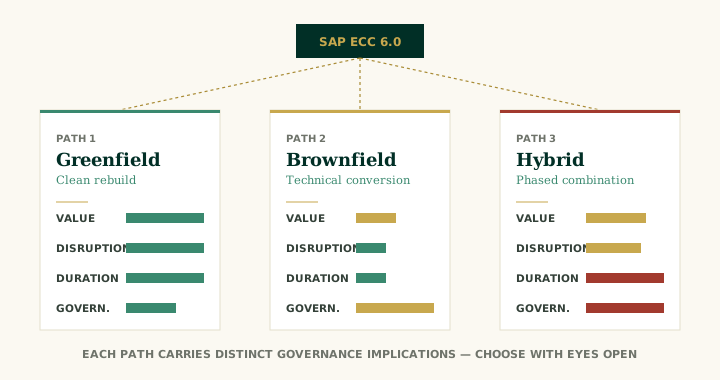
When assessing the path to S/4HANA, boards must ensure that the chosen strategy mitigates risk while maximizing business value. The three primary approaches each carry distinct governance implications:
Highest transformation value, highest near-term disruption. The governance question is whether the business can absorb a parallel operating environment for the duration of the build — and whether the executive team has the appetite to defend a multi-year transformation against quarter-by-quarter operational pressure.
Lowest near-term disruption, but it migrates accumulated technical debt, custom code, and legacy process logic forward. The governance question is whether the board understands what it is preserving — and whether the business is comfortable inheriting today’s constraints into a platform sold on the promise of release from them.
Most flexible in theory, hardest to govern in practice. Hybrid approaches multiply governance surface area: more phase gates, more decision points, more places where a delivery team can quietly reshape scope without the board noticing. Hybrid is the right answer for some organizations — but it is the wrong answer for organizations that choose it because the board could not decide between the other two.
The decision zone — where independent oversight matters most
The structural challenge in most SAP ECC migration programs is not technical. It is governance.
System integrators are engaged to deliver a program. They are not structurally positioned to report objectively on the risks of their own delivery. When the delivery team is also the source of program reporting, the board is receiving filtered intelligence — not independent assurance.
Independent governance oversight, structured outside the delivery team, gives the board direct, evidence-based visibility into program health, migration risk, and the integrity of phase-gate decisions. It is the mechanism by which executive leadership retains control of a program it has commissioned but cannot directly observe.
What the board should be asking now
The SAP ECC 2027 deadline is no longer a future problem. For enterprise organizations with complex landscapes, the window for a governed transition is closing — and the architectural decisions being taken now will be the constraints the business operates inside for the next ten to fifteen years.
The SAP ECC-to-S/4HANA transition is one of the most consequential technology decisions an enterprise board will make in this decade. The organizations that navigate it successfully will not be those with the largest implementation budgets. They will be those with the clearest governance.