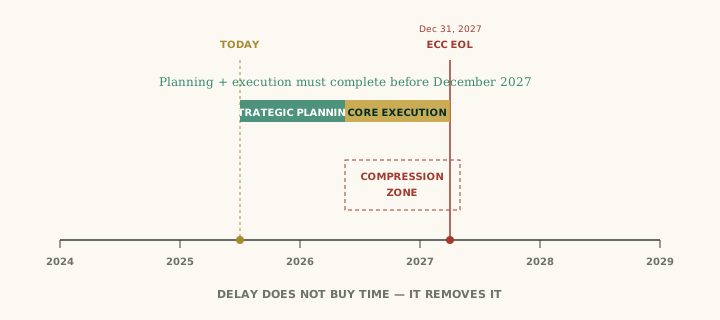
Enterprise boards that wait until 2026 or 2027 to begin SAP ECC migration planning are not buying time. They are eliminating it.
A governed SAP S/4HANA transition for a large enterprise takes several years from strategic planning to go-live. Organisations that compress that window will face reactive, deadline-driven decisions that no governance framework can fully protect against.
With the mainstream maintenance of SAP Enterprise Central Component ending in 2027, the clock is no longer abstract. For enterprise boards, the governance risk of delayed planning is not theoretical — it is structural. Every month of inaction compresses the window for controlled, evidence-based decision-making and increases the likelihood of a program that is reactive rather than governed.
The true S/4HANA implementation timeline
A common pitfall in corporate governance is underestimating the timeline required for a comprehensive ERP transition.
An average SAP S/4HANA implementation for a large enterprise takes 12 to 18 months — and that is just the core execution phase.
When you factor in strategic planning, budgeting, system selection, and extensive change management, the entire lifecycle often spans several years. Organisations that wait until 2026 to begin planning will find themselves forced into rushed, reactive decisions. From a governance standpoint, a rushed ERP implementation is a recipe for budget overruns, operational disruption, and compromised compliance.
What your landscape is hiding
Over the past ten to fifteen years, most enterprise SAP ECC environments have accumulated layers of customisations, third-party integrations, and complex workarounds. These heavily customised systems present governance challenges that are frequently underestimated at the board level.
Custom code that has accumulated organically over a decade. Integrations to systems that no one remembers commissioning. Workarounds that exist because a process changed and the platform didn’t follow. The migration program will surface every one of these — but only after commitment. A governed program surfaces them before.
Independent governance in the decision zone
One of the most consequential governance decisions a board makes during an SAP ECC migration is how it structures oversight of the system integrator.
System integrators are essential for execution. But they are not structurally positioned to report objectively on the program they are delivering. Their commercial interests, contractual incentives, and reputational exposure all create pressure toward optimistic reporting — regardless of actual program health.
This is where independent validation and verification (IV&V) program assurance becomes the board’s primary control mechanism. An independent governance partner, operating entirely outside the delivery structure, gives the board objective visibility into:
Program health that is evidence-based, not reported. Phase-gate decisions backed by independent verification. Custom-code compatibility risk surfaced before commitment, not after. And reporting the board can trust because it does not come from the team being assessed.
What the board must do before the window closes
The window for a governed SAP ECC migration is not closing gradually. It is closing at an accelerating rate.
For large enterprises with complex landscapes, the practical planning horizon is already measured in months, not years. Organisations that begin now will have the time to make deliberate, evidence-based decisions. Those that wait will find themselves managing a deadline rather than a program.