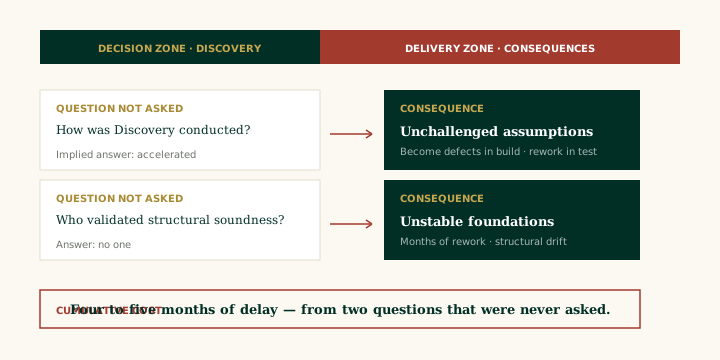
SAP transformations require rigorous governance to avoid costly setbacks. A VP of Finance recently reflected on losing four to five months in her company’s S/4HANA programme — due to insufficient scrutiny of their systems integrator before the project began.
This delay was not inevitable. It stemmed from a failure to address critical questions that expose programme drift and reveal discrepancies between reporting and reality.
In our governance framework, we identify essential questions every board must ask to ensure their SAP transformation governance is robust and effective. For this manufacturer, neglecting just two of these questions led to significant ERP programme risk.
The missing questions in the decision zone
First, the board did not inquire how the Discovery phase was conducted.
“It was accelerated.”
Discovery is the phase where assumptions are tested, data is mapped, and the structural soundness of the programme is established. Accelerating Discovery does not compress the timeline. It defers the consequences. Every assumption that goes unchallenged in Discovery becomes a defect in delivery — or a delay in stabilisation.
Second, they failed to ask who independently validated the programme’s structural soundness. The answer in this case was no one.
Without independent validation, assumptions went unchallenged, allowing programme drift to take hold from the very first month. A project built on unstable foundations resulted in months of rework and delay.
This example underscores the importance of confronting uncomfortable questions early. Boards must move beyond accepting SI assurances at face value and demand transparency to align reporting with reality.
Who is asking the hard questions?
Your board is reviewing the monthly status report for your multi-million-dollar SAP transformation. The Discovery phase was accelerated. The programme is on track. But who independently validated that?
Governance is not a spectator sport. It requires active, uncomfortable interrogation of the people delivering your programme. Accepting reassurance as a substitute for evidence is how boards find themselves approving go-lives on programmes that are structurally unsound.
The questions that would have prevented five months of lost time are straightforward. They just needed to be asked.
Preventing future drift
Boards that rigorously question their SIs and insist on independent validation can prevent programme drift and avoid costly delays.
The cost of neglecting these governance fundamentals is always paid with interest.